
Intent
At Marish Academy Trust, we believe that the Early Years Foundation Stage is crucial in securing solid foundations that children are going to continue to build upon. It is our intent that the children who enter our EYFS develop physically, verbally, cognitively and emotionally whilst embedding a positive attitude towards school and their learning. We aim to support the children in their exploration of the world in a secure and stimulating environment. With all this in mind, we begin each new year by looking at the individual needs of our children. Taking into account their different starting points, we carefully develop our flexible EYFS curriculum which enables them to follow the path of their own learning journey, one that is suitable for their unique needs and stages of development.
Children will be encouraged to become independent learners who:
- co-operate and share
- express feelings and emotions
- fantasise and use their imagination
- investigate and explore
- communicate with others
- develop language
- develop physical skills
The EYFS is based on 4 overarching principles which shape good practice in Early Years settings:
- A unique child – Every child is a They are consistently learning and can be resilient, capable, confident and self-assured.
- Positive relationships – Children learn to be strong and independent through positive
- Enabling environments – Children learn and develop well in environments where their experiences respond to their individual needs and there is a strong partnership between practitioners and parents and/or
- Children learn and develop in different ways and at different rates – The framework covers the education and care of children within the early years setting, including children with additional needs.
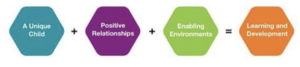
Our curriculum approach supports these principles, ensuring high quality learning experiences are provided to all children.
Implementation
Children in both our Nursery and Reception classes will follow the EYFS curriculum, which has seven main areas of learning:
Prime Areas:
- Personal, Social and Emotional Development
- Communication and Language
- Physical Development
Specific Areas:
- Literacy
- Mathematics
- Understanding of the World
- Expressive Arts and Design
The teaching of these areas of learning is practical and playful with support and challenge from adults in whole class sessions, small group sessions, individual sessions, as well as active engagement during free-flow continuous provision activities.
At the heart of the EYFS curriculum are the ‘Characteristics of Effective Learning’. At Marish Academy Trust, we strive to develop these key characteristics in order to give children the skills they will continue to draw upon throughout their development.
Our curriculum develops a thirst and love for learning by:
- Carefully planning sequences of activities that provide meaningful learning experiences, developing each child’s characteristics of learning.
- Providing high quality interactions with adults that demonstrate and impact on the progress of all
- Using high quality questioning and interactions to check understanding and address
- Staff acting as role models to the children they teach in order for children to develop their own speaking and listening skills.
- Carefully assessing, through observations, which are recorded on These are used to inform the next steps of learning and meet individual needs.
- Developing an effective and engaging environment that is set up so that children can access all areas of learning both inside and outside at any one time.
- Providing activity starting points for child initiated activities that enhance children’s learning and impact on progress.
- Allowing children to be successful in their attempts at an activity and using effective feedback to help facilitate next steps in learning.
- Suggesting home learning opportunities with information about what has been taught, allowing parents to build on their child’s school experiences, at home.
We recognise the changing needs and interests of our pupils and we are responsive to this, regularly developing existing topics.
The Early Years uses core texts as a basis for topic planning and usually start with an exciting hook to engage children in both the topic and the book. In Nursery, staff promote a love of books through shared story sessions. In Reception, children participate in daily guided reading sessions. In EYFS, mark making and writing opportunities are available to all children. A range of literacy opportunities are promoted in many of the continuous provision activities available to children during the week. Phonics is taught daily using the Letters and Sounds programme of study.
Opportunities to develop maths skills are carefully planned using concrete resources and build on prior learning and real life experiences across the theme and year. We want our children to become confident mathematicians who can apply what they have learnt to real life experiences.
There are opportunities to share the children’s learning with their parents and carers through our online learning journey platform, ‘Tapestry’. We have introduced weekly ‘Stay and Play’ sessions for both Nursery and Reception. These sessions allow parents to join in learning activities alongside their children and share the EYFS experience, as well as contribute to their learning journey.
Towards the end of Summer 2, Reception children transition into Year 1. This early transition phase aims to alleviate any concerns the children and parents may have, whilst also introducing new staff and new classrooms. Reception staff are on hand to support the children in their new environments and ensure a thorough handover is completed to Year 1 staff. During this time, home visits are carried out for the new Reception cohort. Transition visits are arranged. Reception staff begin to spend time in Nursery in order to build relationships with the children moving into Reception in September.
Impact
Children become resilient learners. They develop their characteristics of learning and are able to apply their knowledge to a range of situations, making links and explaining their ideas and understanding. Children are confident to take risks and discuss their successes and failures with adults, drawing on their experiences to improve or adjust what they are doing.
Children demonstrate high levels of engagement in a range of learning activities, not only developing their speaking and listening skills, but also broadening their vocabulary. Children develop a wider sense of the world around them and can draw on these experiences during interactions with other and link this to new learning.
From their own starting points, children will make excellent progress emotionally, socially and academically, developing a sense of themselves so that they are well prepared for Key Stage 1.
 If your child is ill and absent from school, you need to tell us through